
Isles of Scilly Ghost Stories: Legends, History and Where to Find Them
A cursed admiral, a singing ghost on the Western Rocks and a cave that swallows people. Discover the Isles of Scilly ghost stories, the real history behind them and the places you can visit today.
Something changed? Tell us
The Isles of Scilly are small, but their ghost stories are not. For centuries, islanders have told tales of drowned sailors, a cursed admiral, a singing ghost and a cave that swallows people whole. Most of these Scilly ghost stories grow out of real events, and you can visit the places where they happened.
This guide gathers the best known ghost stories on Scilly, from Porth Hellick on St Mary's to the lonely Western Rocks. We explain the history behind each one, where the tale comes from and where you can stand today if you want to feel the hairs rise on your neck.
Just remember. Most of these are stories, not facts. That is half the fun.
Key Takeaways
- Sir Cloudesley Shovell sits at the heart of Scilly's most famous ghost story, linked to the 1707 naval disaster and Porth Hellick on St Mary's.
- Opera singer Ann Cargill, drowned in 1784, is said to haunt Rosevear on the Western Rocks.
- Piper's Hole on Tresco carries old tales of a tunnel under the sea and people who never came back.
- Old Town churchyard, St Warna's Well and abandoned Samson tie the islands' ghost stories to real shipwrecks and lost communities.
- Most tales were written down in the 1700s and 1800s, so treat them as folklore built on real history.
Why Scilly has so many ghost stories
Scilly sits in some of the most dangerous water around Britain. Visit Isles of Scilly says there are over 500 registered wrecks around the islands. Every wreck left families grieving and bodies washing ashore. Small, close communities then did what people always do. They turned loss into stories and passed them on.
Many of the tales were written down by visitors in the 1700s and 1800s. Henry John Whitfeld's book Scilly and its Legends, from 1852, records stories from Old Town, Holy Vale, Tresco and St Agnes. You can listen to it free on LibriVox. Storyteller Mike O'Connor gathered more in Isles of Scilly Folk Tales (The History Press, 2020).
The admiral who could not rest: Sir Cloudesley Shovell
What really happened in 1707
On the night of 22 October 1707, a Royal Navy fleet heading home struck the Western Rocks. Four ships went down, including the flagship Association. Admiral Sir Cloudesley Shovell's body was washed about seven miles to Porth Hellick on St Mary's, as the Penwith Local History Group explains. Well over a thousand men died.
He was buried above the beach for a short time. According to Find a Grave, Queen Anne ordered his body dug up and taken to Plymouth to be embalmed. A stone still marks the spot where he came ashore, as recorded by Royal Museums Greenwich.
The curse of the hanged sailor
The darkest Scilly ghost story starts before the wreck. Victorian writer William Bottrell recorded an island tradition about a sailor from Scilly who knew the waters. He warned the admiral the fleet was heading for the rocks. Shovell had him hanged for stirring up mutiny, Bottrell wrote.
 RecommendedSeasons & nightBest Beaches in Scilly: 13 Top Picks, Island by Island12 min read · All islandsRead the story →
Before he died, the sailor asked to read Psalm 109, a psalm full of curses. His last words were that the admiral and everyone who watched him hang would never reach land alive. Hours later, the fleet hit the rocks. For islanders, that was no accident. It was a dead man's curse coming true.
The emerald ring and the grave where no grass grows
A second legend says Shovell reached the beach alive. Years later, an island woman is said to have confessed on her deathbed that she found him breathing, took his emerald ring and killed him. A record from the time, reproduced by HMS Surprise, does say his shirt was taken and his ring was missing.
Bottrell added one more eerie detail. He wrote that the pit of Shovell's first grave at Porth Hellick never filled in, even in the worst storms, and that no grass ever grew on it. Whether that was ever true is anyone's guess. Go and look for yourself, then decide.
Where to feel it today
- Porth Hellick memorial stone: on the coast path on the south east side of St Mary's.
- The Western Rocks: seen from boat trips in calm weather, where the fleet was lost.
The singing ghost of Rosevear
In February 1784, the East India Company packet Nancy was carrying mail from Bombay when a storm drove her onto rocks west of Scilly. On board was Ann Cargill, a famous 23 year old opera singer, with her baby. The Australian National Maritime Museum holds a print of the wreck.
The Gentleman's Magazine reported that her body was found still holding her infant, according to a FIBIS transcript. She was first buried on Rosevear, a bare rock on the Western Rocks, then reburied at Old Town Church on St Mary's, Wikipedia notes. Her ghost is said to haunt Rosevear to this day.
The best version of the tale comes from the 1850s. Men building Bishop Rock lighthouse lived and worked on Rosevear. The Nautical Archaeology Society says they found human bones in the thin soil. Some were sure they heard a young woman singing a lullaby to her baby on stormy nights.
The story still has a twist. In 2008, local divers Ed Cumming and Todd Stevens said they had found the Nancy further out than anyone expected, as History News Network reported. Older records had mixed up the ship with its lifeboat, which was the boat driven onto Rosevear.
Landing is not allowed on Rosevear, Wikipedia notes, so this pin is for spotting it from a boat trip around the Western Rocks.
Piper's Hole: the cave that swallows people
Piper's Hole is a sea cave at the north end of Tresco. Inside, a boulder strewn entrance opens onto a cold freshwater pool, a tiny gravel beach and a narrow granite passage about 30 metres long. That is how Tresco Island describes it after residents explored it by torchlight.
 RecommendedHistoryShovell’s Fleet: The 1707 Sailors Buried on St Agnes5 min read · St AgnesRead the story →
Legend says the cave runs under the sea to a second Piper's Hole at Peninnis on St Mary's. Robert Heath wrote in 1750 of men who went in and never came back, and dogs that came out on Tresco with most of their hair gone. Robert Hunt repeated the tale in the 1800s.
Not everyone believed it. In 1861, J O Halliwell Phillipps called the idea absurd, since the tunnel would need to be at least four miles long, as The Modern Antiquarian quotes. Other stories say a mermaid lived there. The name may simply come from old clay pipes, Tresco Island suggests.
Visiting Piper's Hole safely
Tresco Island is clear that you visit at your own risk. The way in is dangerous. Follow their advice:
- Go at low tide and in good weather only.
- Never go alone, and tell someone your plans.
- Take a good torch.
St Agnes and the saint of shipwrecks
On the south west coast of St Agnes lies St Warna's Well. Historic England says Heath described Warna in 1750 as a helper in hard times, best known for bringing wrecks to the island. Islanders cleaned the well each year. A later account says they dropped crooked pins in to call on her help.
It sounds sinister, and Victorian writers made the most of it. Tales spread of St Agnes people luring ships with false lights. Historian Cathryn Pearce, writing in the National Maritime Museum Cornwall's journal Troze, shows how these lurid stories grew over time. Most historians now discount the false lights.
Close by on Wingletang Down is something quieter and sadder. Historic England protects a single shipwreck grave near Crooked Rock, a rare survivor of the way drowned strangers were once buried near where they washed up.
Old Town churchyard: where the drowned are buried
Old Town Church on St Mary's dates from the 12th century. Wikipedia notes that generations of island families lie here, along with the crews of many ships lost nearby. The churchyard also holds mass graves of passengers from the SS Schiller, which sank in 1875. Few places on Scilly feel heavier.
The Schiller hit the Retarrier Ledges in thick fog in May 1875. Around 372 people were on board and only 37 survived, says Strolling Guides. The tallest monument here remembers Louise Holzmaister, a young passenger. Her husband put it up. Her body was never found.
The Isles of Scilly Museum ran a Voices from the Past churchyard tour in April 2026, where characters from island history told their own stories. The museum's new home in the Town Hall is due to open in early summer 2027, so watch for more events.
Samson: the island people left behind
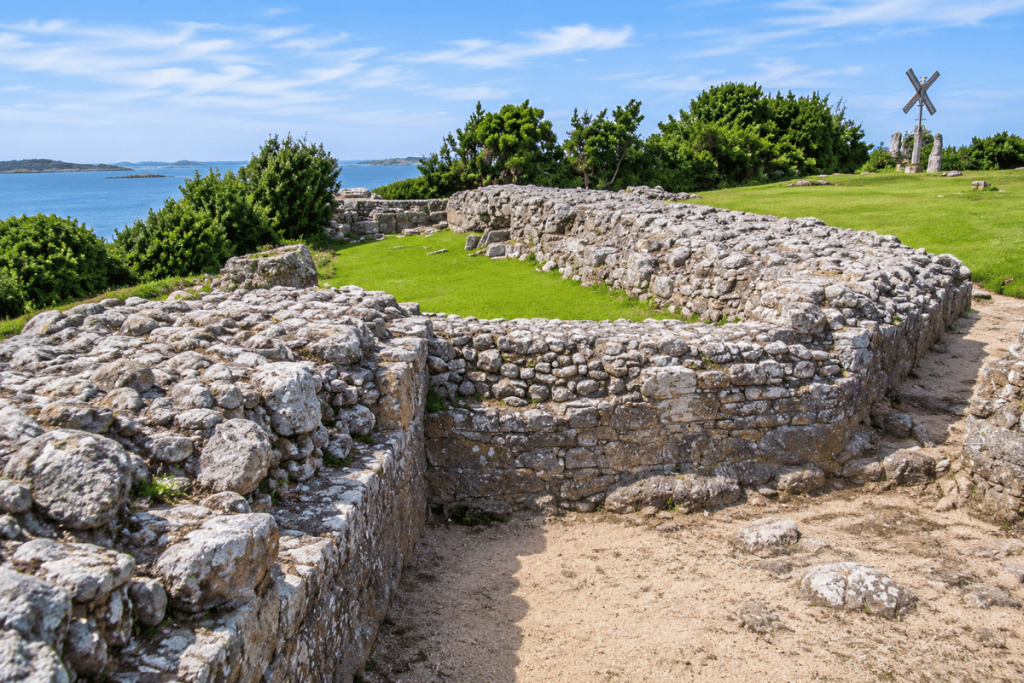
Samson is the largest uninhabited island on Scilly. People lived there until 1855, when Augustus Smith moved out the last two families, the Woodcocks and the Webbers. Wikipedia records they were living in deep poverty on limpets and potatoes. In the 1700s, local leaders also used Samson to banish "undesirables".
 RecommendedHistorySS Headlands: Torpedoed South of Scilly3 min read · South of ScillyRead the story →
Island lore tells a more tragic version. One popular tale says Samson emptied after most of its men drowned trying to rescue sailors from a wreck, as The Modern Antiquarian retells. The records point to hunger and Smith's decision instead. Either way, the empty cottages on South Hill feel full of the past.
Michael Morpurgo used that feeling in Why the Whales Came, where Samson lies under a curse. Boat trips land visitors by plank in summer, and there are no facilities, so take food and water. Check the boards on St Mary's quay or the Scilly Live board for sailings on the day.
Lyonesse: the bells beneath the waves
The oldest ghost story of all is a whole drowned land. Lyonesse was said to stretch from Land's End to Scilly until the sea swallowed it in one night. Only one man, riding a white horse, escaped. The Valley Cornwall notes that people still claim to hear its church bells ringing under the sea.
There is real history under the legend. At very low tides, old field walls appear on the sands between Samson, Bryher and Tresco. These are the remains of farms flooded as sea levels rose. Stand on Samson Flats at low water and it is easy to see why the story never died.
Phantom ships and Star Castle
In its 2025 Halloween guide, Visit Isles of Scilly lists ghost ships seen in the fog. They include Sir Richard Grenville's Revenge, the Flying Dutchman, Viking longships and haunted lighthouses. These are wider sea legends. The real Revenge was lost near the Azores in 1591, so its link to Scilly is loose.
For a spooky night indoors, there is Star Castle on the Garrison. It was built in 1593, says its Historic England listing, and its bar was once a dungeon where prisoners were held, according to Cool Places. Visit Isles of Scilly jokes there are a few ghosts in its corridors.
Where to find Scilly's ghost stories
| Story | Where | Island | How to visit |
|---|---|---|---|
| Sir Cloudesley Shovell's curse | Porth Hellick memorial stone | St Mary's | Coast path walk |
| The singing ghost | Rosevear, Western Rocks | Uninhabited | View from a boat trip |
| The endless tunnel | Piper's Hole | Tresco | Low tide only, never alone |
| The saint of wrecks | St Warna's Well | St Agnes | Coast path near Wingletang Down |
| The drowned of the Schiller | Old Town churchyard | St Mary's | Walk from Hugh Town |
| The abandoned island | South Hill cottages | Samson | Summer boat trip |
| The bells of Lyonesse | Samson Flats | Between Samson and Bryher | Very low tides |

Tips for your own Scilly ghost trail
- Check tides and boats first. Samson, Piper's Hole and Samson Flats all depend on the tide. Use the Scilly Live board for boat times.
- Go in autumn. Quieter paths, early dusk and sea mist suit these stories best.
- Read before you go. Whitfeld's 1852 book and Mike O'Connor's folk tales add rich detail.
- Be respectful. Churchyards and wreck graves are real resting places, and many uninhabited islands are protected for wildlife.
Ghosts or not, every one of these tales points back to real people. Sailors, singers, saints and island families all left their mark on Scilly. Walk in their footsteps, listen to the sea, and you may find the stories stay with you long after the boat home.
Last checked October 2026