
Troy Town Maze: The Pebble Labyrinth of St Agnes
On the west side of St Agnes is a small labyrinth of beach pebbles. Tradition says a lighthouse keeper's son laid it out in 1729, though it may be far older than that.
Something changed? Tell us
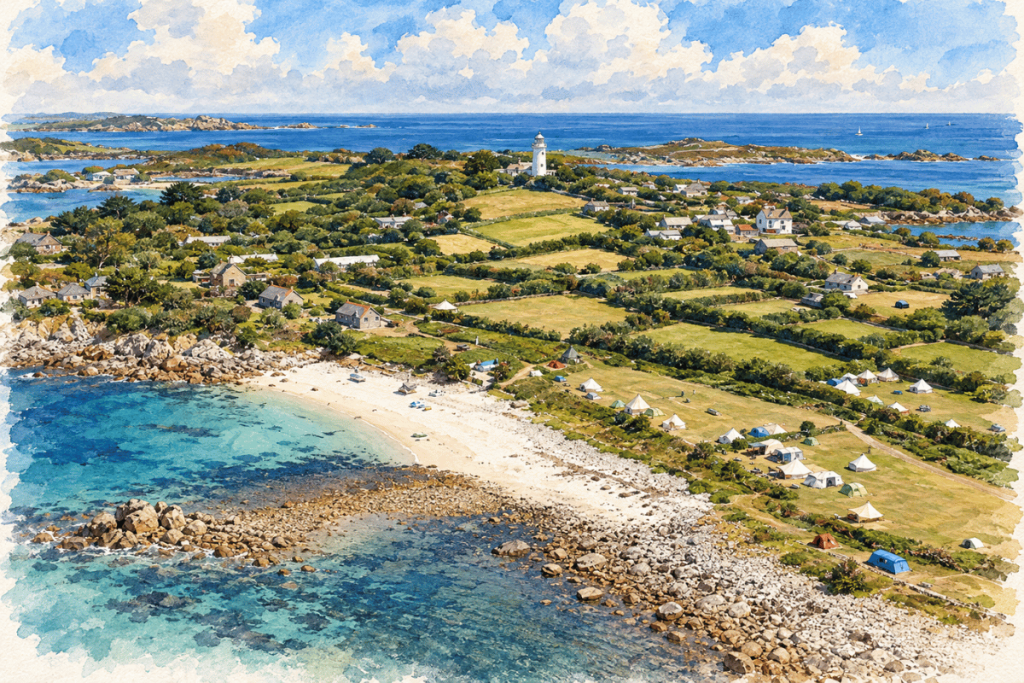
On a grassy slope above the sea on the west of St Agnes lies a spiral of pebbles. This is Troy Town Maze. It is only a few metres across, but it has puzzled people for 300 years. Nobody is quite sure who made it, or when. That uncertainty is part of its charm.
Key Takeaways
- Troy Town Maze is a labyrinth of beach cobbles on Castella Down, St Agnes.
- Local tradition says Amor Clarke, a lighthouse keeper, made it in 1729, but it may be older.
- It has been rebuilt at least once, yet still matches a photograph from 1885.
- It is a Scheduled Monument and is thought to be unique in England.
Who made the maze?
The usual story says the son of a St Agnes lighthouse keeper laid out the maze in 1729. Historic England records a local tradition that names Amor Clarke, a keeper of the light, as the maker. Either way, the link to the lighthouse is strong. But none of it has been proved.
Some think the maze is much older. Wikipedia notes that it may predate 1729, and that an unofficial rebuild in 1988 may have destroyed any buried clues to its origins. So the date stays a tradition rather than a fact. The pattern itself, though, is ancient and found right across Europe.
What it looks like
The maze is roughly oval, about 5.5 metres by 5 metres, according to Historic England. Single lines of beach cobbles are set into the turf. The path leads you from side to side, back out to the edge, and finally to the centre. Feet have worn the paths bare and slightly hollow.
 RecommendedBoats & waterKayaking on the Isles of Scilly: Hire, Tours and Where to Paddle4 min read · All islandsRead the guide →
Strictly speaking it is a labyrinth, not a maze. There is one path in, and you cannot get lost.
Why is it called Troy Town?
Turf and stone labyrinths across Britain are often called Troy Towns. Wikipedia links the name to a legend that the walls of Troy were so confusing that no one could find a way out. Similar names turn up in Wales and Scandinavia. The St Agnes maze keeps that old name alive.
Rebuilt, but still the same
Historic England says the maze has been rebuilt on at least one recent occasion. Even so, its pattern matches a photograph taken in 1885, so the original design has survived. It is the only pre 20th century British maze made from cobbles in this way, which is why it is a Scheduled Monument.
Copies across the islands
The maze has inspired many copies. Visitors have built pebble mazes all over Scilly, and Historic England sees this as a sign of how much people love the original. The Isles of Scilly Museum runs a Labyrinth Summer Festival on the first weekend of August, celebrating the islands' maze folklore.
Visiting Troy Town Maze
- Find it on Castella Down, on the west side of the island near Troytown Farm.
- Walk the path to the centre, it only takes a minute or two.
- Leave the stones alone. It is a protected monument, so please don't move or add pebbles.
- Stay for sunset. The west coast faces straight out to the Western Rocks.
- Treat yourself to an ice cream at Troytown Farm nearby. Our St Agnes guide has more.
 RecommendedHistoryIsles of the Dead? The Story of Scilly’s Bronze Age Tombs5 min read · St Mary's & off-islandsRead the guide →
Last checked October 2026